

Today, there was a piece of news regarding Auroora:
Certain shareholders of Auroora sold a total of approximately 3.9% of the company's shares in an accelerated bookbuilding process at a price of EUR 9.40 per share. Prior to the transaction, the sellers owned around 11.1% of the company and sold approximately one-third of their holdings. Thus, the sellers will remain significant owners of the company (with a holding of over 7%). The sellers have committed to a new 90-day lock-up period. Thus, it is possible that the share will face new selling pressure when this has lapsed. It is not yet known who the sold shares went to, but the transaction is likely to broaden the company's owner base and may thus improve the liquidity of the share in the longer term. - Inderes
We don’t necessarily buy into the argument of more liquidity being better for long-term shareholders. More shareholders also means more jittery around earnings reports not meeting expectations. The seeds for high IRRs are oftentimes being planted when the story’s under-followed…
With the stock now yielding a blended CAGR of 15.8% (combining several scenarios on valuation and reinvestment rate for M&A), it presents a good buying opportunity for newer investors. Auroora’s stock volatility does not change the IRR dynamics for us.
As we’ll write in the upcoming Q3 letter:
As the share price had increased by over 100% since we pitched it, it shouldn’t come as a surprise that we’ve “eaten” into the forward CAGR potential. When you buy a stock at a 17/18-ish percent annualized return, and it rallies 100% in three months, you’ve pocketed 4 years of future compounding all at once. Unless there’s been a dramatic change in intrinsic value, the forward returns should be lower from here. And indeed, we’ve raised our assumptions quite a bit but the implied IRRs at today’s prices have still declined. The fact is that they’re still good, and investor expectations haven’t become too bullish just yet.
Nevertheless, we find it logical to point out to new readers that an 11-ish percent base case CAGR isn’t all that compelling for a smaller-sized serial acquirer. We don’t know whether that will be the case over the next months but that’s how sentiment works.
Just after we sort of “downgraded” the recommendation from “BUY” to “HOLD”, the stock dropped by over 25% in four trading days. That was a good breather for newer subscribers to initiate a position, and at 10.4 EUR, we lifted our stance to “BUY” again. At the end of the quarter, some of the larger shareholders who had agreed to a lock-up period sold off close to 4% of the share count at 9.4 EUR, and so the stock tanked again.
Trading at a tad below 9x NOPAT for FY28 (pro-forma), excluding a small debt position, we believe valuation gives a healthy IRR from here.
We bought our position very well (CAGR on cost of close to 20% with a 12x exit multiple), and now we let run (or better fluctuate). The stock’s recent volatility does not change our expected return forecasts (relative to our cost basis) one bit as we haven’t added to our position at the peak levels. We haven’t chased it at underwhelming forward IRRs.
The last line is critical - we focus on the IRR for every incremental euro/dollar of invested capital. As our portfolio’s now yielding a forward IRR of >18% (and 18.5% when including buybacks) supported by earnings growth and ROIIC, the hurdle is ambitious (a bit of a problem when finding new ideas) but also indicative of our companies’ compounding potential.
We own Auroora at an IRR on cost of 19.5%, and we’re not planning to dilute it when the embedded assumptions look to be reasonable. Below’s the base case.
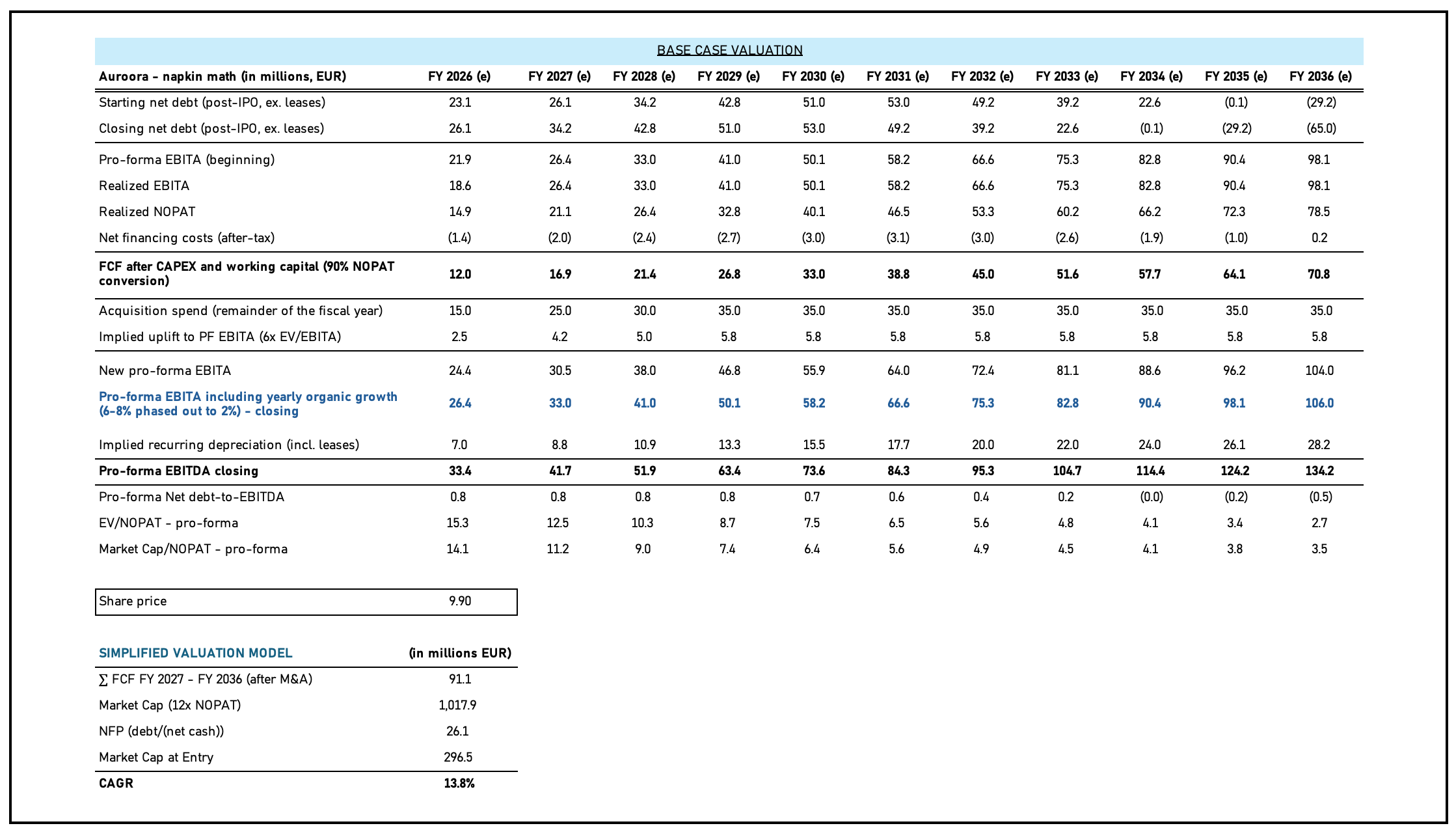
Note: as can be read in our in-depth report, we’re a tad more cautious on effective FCFs as the timing of acquisitions, the mix of acquired entities, working capital volatility, et al can have an impact. Basically, we assumed that only fully-consolidated entities at the end of the fiscal year will generate FCF the year after, thus not accounting for any interim FCFs from newly acquired companies in the upcoming year. That way, we leave more wiggle room on the debt level to execute on more M&A, pay dividends, or repay debt.
The CAGR impact of understating FCFs a bit is deemed small (20 bps) and it would be offset by dividend withholding taxes. We don’t want to split hairs on a couple of bps in CAGR. Far more relevant is to see the big picture for the ROIICs, reinvestment rates… being very attractive over the foreseeable future.
Furthermore, we’d like to remind our readers that our pro-forma FY26 NOPAT does include one or two new M&A transactions. Thus far, it’s been a little over three months since the last announcement.
Bought More of The Beauty Tech Group
Nevertheless, we’ve allocated more capital at >20% IRRs over the past weeks elsewhere. Putting some more of our excess cash to work, we still believe TBTG’s commitment to returning excess FCF (which is basically 70-75% of EBITDA) to shareholders is underestimated.
Yesterday, we reached out to IR to verify what the plan is, and it’s clear: returning all excess cash in a manner that maximizes value for shareholders. In other words, and consistent with what we shared yesterday, this will be the first buyback of many. The next repurchase program could be announced within two months with a trading update (and subsequent upgrade to the FY26 guide).
