
Q3 2026 - AutoZone
Incrementally growing FCF & OPEX leverage on a per-store basis - softer comp in the final part of the quarter needs context

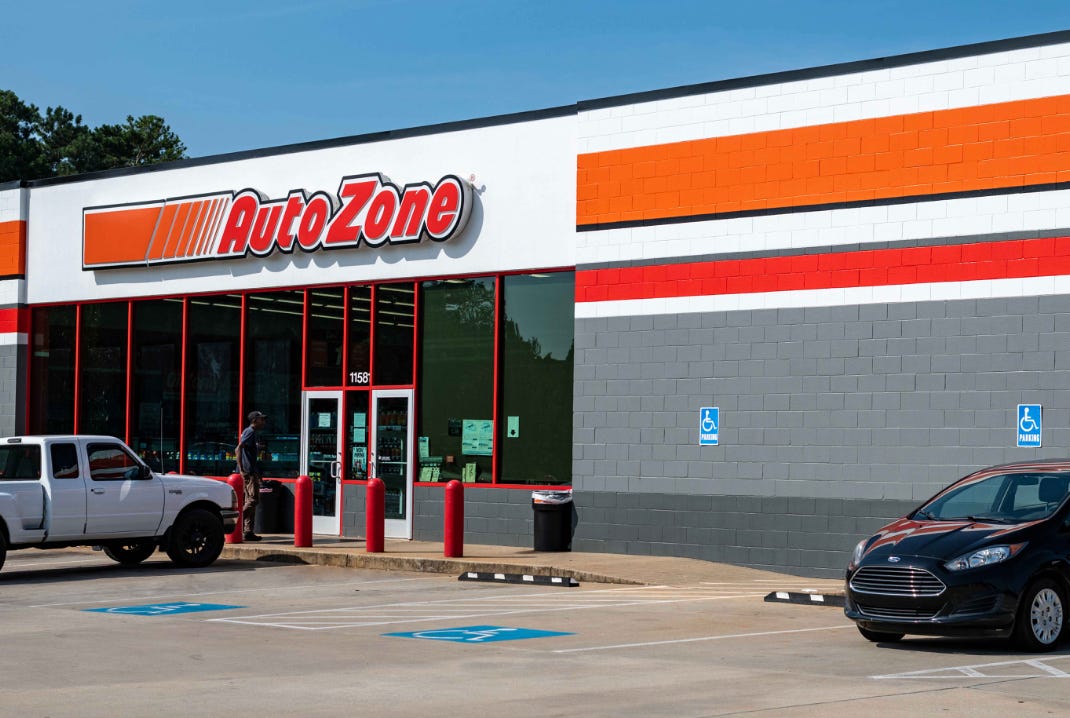
Yesterday, AutoZone released its Q3 2026 earnings report. Shares were briefly down 12%, the biggest intraday drop on earnings in a long time. We personally cannot remember such move for AutoZone, especially as the report was very much in line with expectations and did not prompt a downgrade in forward growth estimates.
We attribute the sharp share price reaction to a couple of factors, some of which should have been well-known by the market and are temporary in nature:
LIFO charge leading to a meaningful headwind to gross margin and EBIT dollars, partially offset by an FX tailwind;
ROIC going down from the mid-forties to the mid-thirties (and likely low-thirties by mid-2027);
FCF still being a bit pressured by the higher CAPEX;
International growth has been soft compared to the recent years. Investors were hoping for international to remain strong and allow AutoZone’s total growth to be close to O’Reilly’s.
The decelerating comp in the last segment of the quarter due to unfavorable weather (that will likely be reversed in the biggest sales and margin quarter, i.e., the current Q4). Investors don’t buy the weather element and see the decelerating comp as a bad omen for the economic health of the typical DIY consumer.
The fifth point is what’s spooked the market even as AutoZone’s fiscal quarters do not match the calendar’s. Q1 was strong for O’Reilly due to higher same-SKU inflation and the timing of tax refunds. AutoZone did benefit from the same factors but it was diluted by weather related weakness in the final part of the quarter as the quarter ran till the first and seasonally cool week of May.

However, one of the highlights from the Q3 results is that AutoZone demonstrated that slowing growth in SG&A per store is a muscle they can flex well. At the same time, it’s not been slowing down on its growth initiatives and the continued increase in large and one-time CAPEX spending has been a drag on gross profit and EBIT through higher depreciation.
Based on its FCF, growth in EBITDAR, and the leverage target of 2.5x, we foresee a total buyback firepower of 4.7-4.8 billion USD by the end of FY27. That’s 9% of today’s float. By FY28, the total cumulative buybacks should amount to something like 8-8.2 billion USD - 16% of today’s float. Clearly, buying back shares at a 13.5x vs. 20x NOPAT is a lot more enticing, provided the business fundamentals remain unchanged or have improved.
We’ve been following and/or owning AutoZone and O’Reilly for a long time, and we know that, irrespective of the fundamental performance, their share prices can drop pretty substantially (as illustrated in the Q1 2026 letter). AutoZone’s now in a 29% drawdown, the largest since 2017 (COVID was a one-off), so catching it during negative momentum does not feel comfortable even as the seeds for abnormally high forward returns have been planted during those periods.
After having sold out last September (near the all-time highs - pretty convenient in hindsight), we re-entered a starters position in AutoZone at roughly 3,300 USD for an all-inclusive IRR of 12.1% late March. With the lower share price and the greater accretion from buybacks (lower prices with unchanged fundamentals), the forward IRR is now at 13.5-14%.
Let’s take a closer look at the quarterly report.